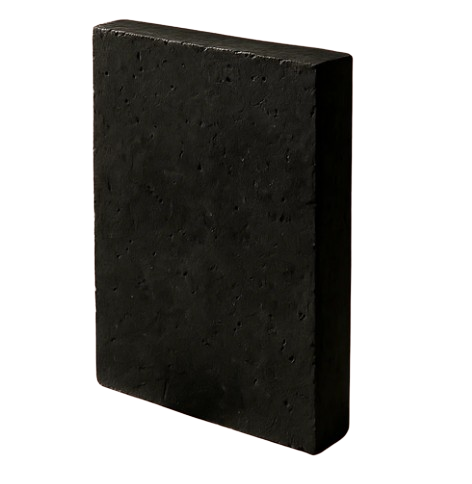
Our Approach
We’re focused on one thing right now:
Proving that biochar-enhanced concrete works at industrial standards — without changing how concrete is made.
Our work current progress has proven carbon neutral biochar can be just as strong as conventional concrete.
Using rigorous, and evidence-driven. We’re validating performance, understanding the material, and mapping the full pathway from biomass to carbon-storing concrete.
Concrete has a carbon problem.
Biochar has a carbon solution.
Our current work sits at the intersection of the two.
We replace part of the mineral aggregate with engineered, activated biochar — a stable carbon-rich material created from plant matter.
This simple swap integrates directly into existing batching lines, maintaining strength and consistency while storing carbon.
But to understand why this works, it helps to look at the full system.
From Biomass to Biochar to Concrete
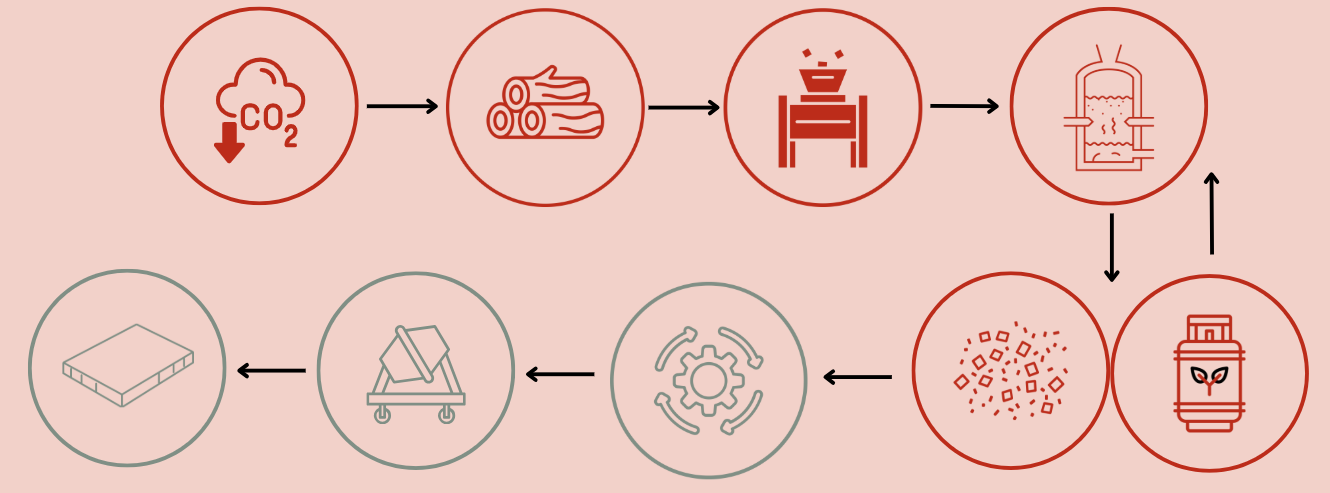
1. Biomass → Biochar & Syngas
Plant matter captures CO₂ from the atmosphere as it grows.
When we thermally decompose this biomass in a low-oxygen environment (pyrolysis), two things form:
Biochar: a stable, carbon-heavy solid
Syngas: a high-energy gas usable for heat or power
Biomass enters the pyrolysis unit, and the syngas loop powers the process, making the system carbon-efficient.
The result:
Carbon that was in the atmosphere is now locked into a stable solid form.
2. Biochar → Engineered Material
Raw biochar is not ready for concrete.
We adapt it to:
Improve stability
Control particle size
Enhance dispersion in concrete
Maintain mix consistency
Support workability and strength
This step is essential — and is a core part of our current work.
3. Engineered Biochar → Concrete
Once processed, the biochar replaces a portion of the fine aggregate.
This requires:
No new equipment
No changes to batching lines
No new curing regime
The result is concrete that performs like conventional material but carries a radically different carbon profile
What We’re Doing Now
Performance Testing
Strength, absorption, density, and durability compared against EN standards.
Mix Consistency
Ensuring stable and repeatable behaviour across batching cycles.
Material Adaptation
Optimising biochar treatment, particle characteristics, and processing.
Industrial Compatibility
Demonstrating that manufacturers can use biochar-enhanced mixes with zero change to existing equipment.
Data Generation and Partner Validation
Looking for industry and academic partners to build the evidence base
Where We’re Going
We’re building toward carbon-negative concrete — not just lower-carbon, not just neutral.
Based on the pathway shown in our process schematic and early material balances, we believe this technology can reach –100 kg CO₂e per tonne of concrete with the right optimisation of:
biochar production efficiency,
activation and adaptation,
mix design, and
manufacturing integration.
This is the direction we’re pushing:
Concrete that permanently stores more carbon than it emits.
What We’re Making Now
Compressive strength: ~40 MPa
Flexural strength: ~4.5 MPa
Water absorption: <6%
Embodied carbon neutral: from +130 kg CO₂e/t to 0 kg CO₂e/t